Hiring for skills? Start with the work—not the wish list.
A six-step job-brief playbook for making tasks, evidence and training needs clear before you interview.
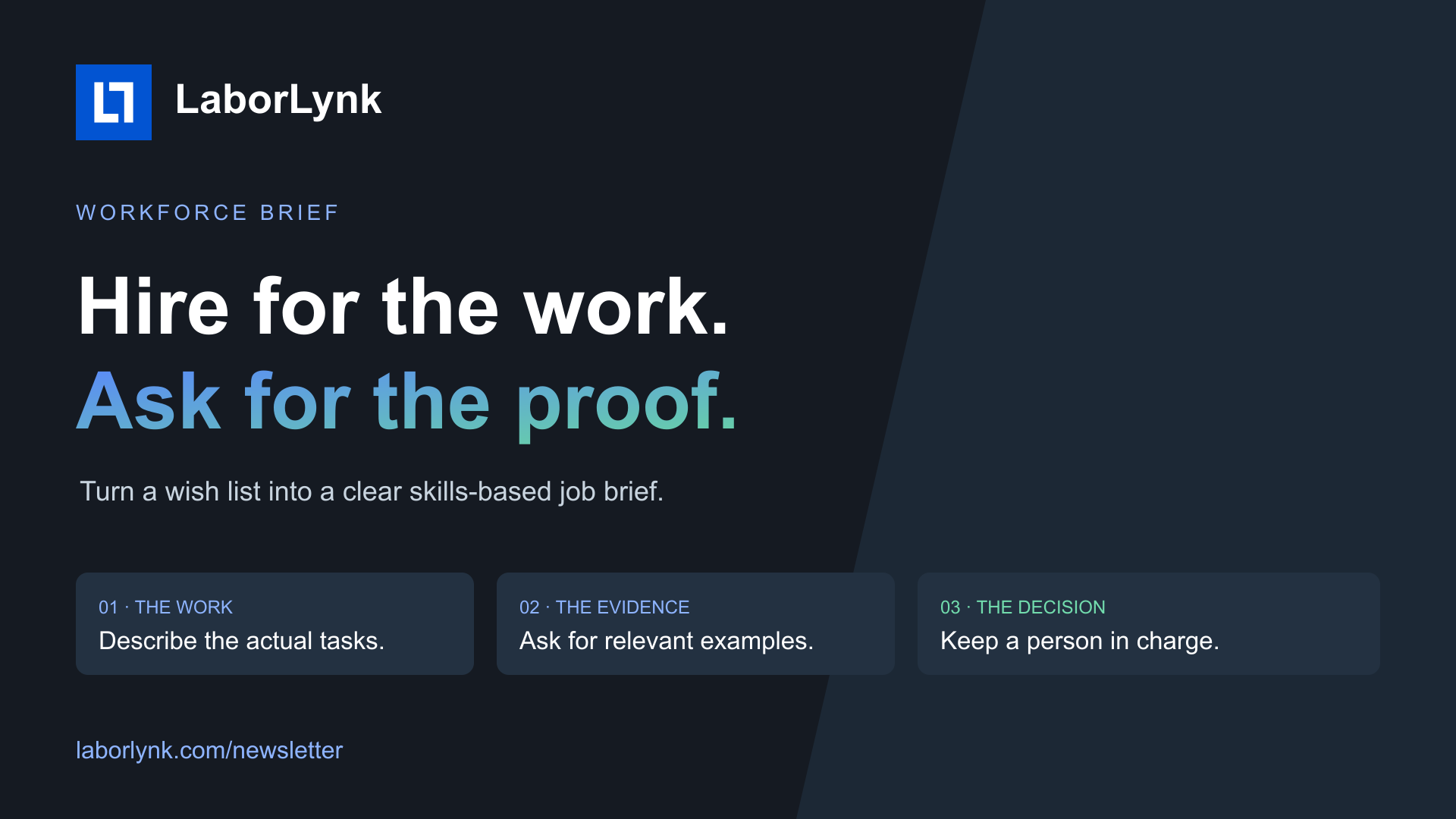
A job description can list years of experience, software names and certifications without telling a candidate what the work actually involves. That leaves employers guessing about fit—and workers guessing about whether to apply.
Before adding another requirement, describe the work someone needs to perform and the evidence that would help you evaluate it. Here is a practical six-step starting point for a skilled-trades role.
1. Name the work
Write three tasks the person will actually perform. For a made-up maintenance role: inspect equipment, troubleshoot a fault and document the repair. Describe the equipment and working context without sharing confidential plant information.
2. Separate day-one needs from teachable skills
Mark which skills are needed before starting and which can be developed with supervision. State the support and training you can genuinely offer. Do not turn a preferred skill into an unexplained requirement.
3. Ask for relevant evidence
Choose an example, credential, work sample or structured discussion that relates to each task. A profile label alone is not proof of every skill. Check what the evidence covers, who supplied it and what remains unconfirmed.
4. Use the same core questions
Ask candidates to describe a relevant situation, the action they took and how they checked the result. Use a simple rubric tied to the task. Keep any demonstration appropriate to the role and supervised; an interview should not become unsupervised hazardous work.
5. Make the next step visible
Tell the applicant what happens after review: interview, clarification or a decision. Assign someone to communicate the next step. A status label is useful only when the team knows who acts next.
6. Review the match as a person
Compare the evidence with the original tasks. Record demonstrated strengths, gaps and the next training step. A human owns the hiring decision. Treat incomplete evidence as a question to resolve, not a fact to invent.
Copy this job-brief checklist.
Role and working context:
Three tasks the person will perform:
Day-one requirements:
Skills we can teach and support:
Evidence to request for each task:
Core interview questions and rubric:
Reviewer and next-step owner:
What we still need to verify:
Check the brief before using it.
- A worker can explain what the job involves after reading the brief.
- Each must-have requirement connects to a real task.
- Evidence is relevant and its limits are understood.
- Training commitments match what the employer can provide.
- Reviewers use the same core questions and know who communicates next.
Workers can use the same brief to explain a relevant example. Training providers can use it to clarify which tasks their programs teach. The common language is the work—not a pile of keywords.
Join LaborLynk Workforce Brief.
A useful lesson for skilled work, hiring and training. Email signup is optional and separate from creating an account.
Already subscribed? Use the unsubscribe link in any Workforce Brief email. If you need help changing your email preferences, contact support@laborlynk.com. Unsubscribing does not delete your LaborLynk account.